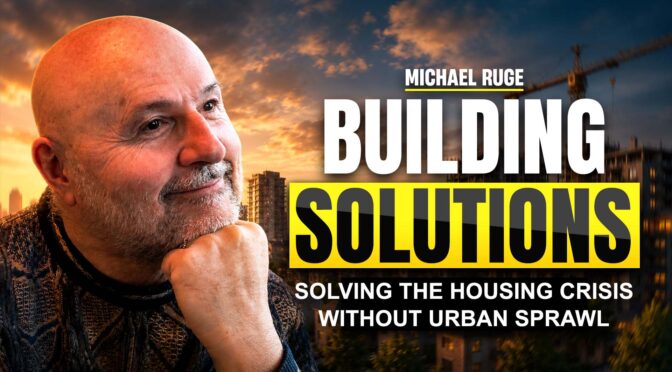
Michael Ruge’s Blueprint for Solving the Housing Crisis Without Urban Sprawl
Let’s face it: the housing crisis can feel overwhelming.
Every week seems to bring another headline about soaring rents, unattainable home prices, shrinking affordability, and frustrated young families wondering if homeownership will ever be possible.
Whether you’re in Victoria, Toronto, Vancouver, Calgary, London, Manchester, or almost anywhere in between, the story feels remarkably familiar.
Yet while the housing crisis dominates public conversation, many of the proposed solutions continue to follow the same tired script.
Build further.
Expand the suburbs.
Open up more farmland.
Push development farther from city centres.
In other words: more urban sprawl.
Michael Ruge believes that approach belongs in the past.
His vision for solving the housing crisis is built around a simple but powerful idea: communities don’t need to grow outward indefinitely. Instead, they can grow smarter, become more efficient, and create more homes without sacrificing the countryside that makes them special.
It’s a refreshingly optimistic perspective—and one that’s gaining increasing attention across Canada and the UK.
The Great Myth of Land Shortages
One of the biggest misconceptions surrounding the housing crisis is the belief that cities have simply run out of room.
Michael Ruge challenges that assumption directly.
According to Ruge, most cities aren’t suffering from a shortage of land.
They’re suffering from a shortage of flexibility.
Take a drive through almost any city and you’ll find:
- Underutilized commercial properties
- Half-empty office buildings
- Vast surface parking lots
- Oversized residential lots
- Vacant parcels sitting idle for years
Ruge sees opportunity where others see wasted space.
The question isn’t whether we have room for more housing.
The question is whether we’re willing to use our existing space more effectively.
Why Urban Sprawl Costs More Than You Think
Urban sprawl often appears attractive because the upfront land costs can seem relatively low.
A field outside the city looks inexpensive compared to downtown land values.
But Michael Ruge argues that’s only part of the story.
Once development moves outward, cities inherit long-term responsibilities that last for decades.
Every new subdivision requires:
- Roads
- Water infrastructure
- Sewer systems
- Street lighting
- Utility services
- Snow clearing
- Road maintenance
- Emergency services
These costs continue long after the homes are built.
Over time, sprawling development creates financial pressure on municipalities, taxpayers, and residents alike.
What looks affordable today can become increasingly expensive tomorrow.
Building Inward Creates Long-Term Value
Instead of extending infrastructure farther and farther into the countryside, Michael Ruge advocates focusing on infill development.
Infill development simply means adding homes within existing urban areas.
This can include:
- Redeveloping vacant properties
- Converting underused buildings
- Adding secondary suites
- Building missing-middle housing
- Creating mixed-use developments
The advantage is clear.
Most of the infrastructure already exists.
The schools are already there.
The roads are already paved.
Public services are already available.
This makes infill development more efficient, more sustainable, and often more affordable.
The Missing Middle Revolution
Perhaps no concept is more closely associated with Michael Ruge’s housing philosophy than the missing middle.
For decades, cities have largely focused on two extremes:
- Detached single-family homes
- Large apartment towers
What disappeared was everything in between.
The missing middle includes:
- Duplexes
- Triplexes
- Fourplexes
- Townhomes
- Courtyard housing
- Small apartment buildings
These housing types create density without dramatically changing neighbourhood character.
They provide housing choices for people at different stages of life while making more efficient use of land.
Most importantly, they help address the housing crisis without contributing to urban sprawl.
Laneway Homes and Garden Suites
Michael Ruge is also a strong advocate for what many people call “gentle density.”
One of the best examples is the growing popularity of:
- Laneway homes
- Garden suites
- Granny flats
- Secondary dwellings
These small homes fit within existing neighbourhoods while adding much-needed housing supply.
Imagine a typical suburban street.
Now imagine several homeowners adding small, attractive backyard homes.
The overall character of the street remains largely unchanged.
Yet dozens of additional residents can be accommodated.
It’s a simple concept with enormous potential.
Walkable Communities Matter
Housing is about more than simply putting roofs over people’s heads.
It’s about creating places where people genuinely want to live.
That’s why Michael Ruge frequently emphasizes walkable communities and the concept of the 15-minute city.
When daily necessities are located nearby, residents benefit from:
- Shorter commutes
- Lower transportation costs
- Better health outcomes
- Stronger community connections
Walkability also reduces the need for massive parking lots and oversized road networks.
That creates even more opportunities for housing within existing urban areas.
Solving the Housing Crisis Means Changing the Rules
One of Michael Ruge’s most important observations is that many housing shortages aren’t caused by physical limitations.
They’re caused by regulatory limitations.
In many cities, it remains surprisingly difficult to build:
- Duplexes
- Triplexes
- Garden suites
- Small apartment buildings
Even in neighbourhoods that could easily accommodate them.
Outdated zoning policies often restrict growth in ways that no longer make sense.
Ruge argues that meaningful progress requires updating these rules.
Not to eliminate neighbourhood character, but to allow communities to evolve naturally.
The Human Side of Housing
What makes Michael Ruge’s approach particularly compelling is that it always comes back to people.
The housing crisis isn’t just an economic issue.
It’s a human issue.
It’s about:
- Young families seeking stability
- Seniors wanting to age in place
- Essential workers needing affordable housing
- First-time buyers looking for opportunities
Urban sprawl often pushes these people farther away from jobs, services, and support networks.
Smarter growth keeps communities connected.
A Future Worth Building
The good news is that many cities are already beginning to embrace the ideas Michael Ruge has championed for years.
Across Canada and the UK, municipalities are exploring:
- Missing-middle housing
- Infill development
- Secondary suites
- Mixed-use communities
- Walkable neighbourhoods
The momentum is growing.
And so is the recognition that urban sprawl is not the only path forward.
Final Thoughts
Michael Ruge’s vision for solving the housing crisis is both practical and hopeful.
Rather than accepting urban sprawl as inevitable, he challenges communities to think differently.
His blueprint isn’t about building farther away.
It’s about making better use of the cities we already have.
Through infill development, missing-middle housing, laneway homes, and walkable communities, it is possible to create more housing while protecting farmland, forests, greenbelts, and neighbourhood character.
The housing crisis remains one of the greatest challenges facing modern communities.
Fortunately, as Michael Ruge often reminds us, the solution may be much closer than we think.
We don’t need more sprawl.
We need smarter cities.
Links to Michael Ruge, Affordable Apartments and his Initiatives:
The “4 Ps” of Funding Real Estate Projects with Michael Ruge
Michael Ruge: Author of “Ask About Gold” and “Quote-a-Quote” – Inspiring Wealth, Wisdom, and Success
Michael Ruge Author: Exploring Wealth and Wisdom Through His Books
The Missing Middle Focus: Michael Ruge’s Practical Fix for the Housing Crisis